HarmonyOS · HackYeah 2026
Tiny apps, made by asking.
Describe what you need in one sentence and Harmoniser builds a capsule: a small, single-purpose app that runs natively on HarmonyOS. Capsules are plain JSON, checked against a strict schema, and can only use the device features you allow.
Experimental research build, tested on the HackYeah API 24 emulator.
How it works
Step 1
Ask
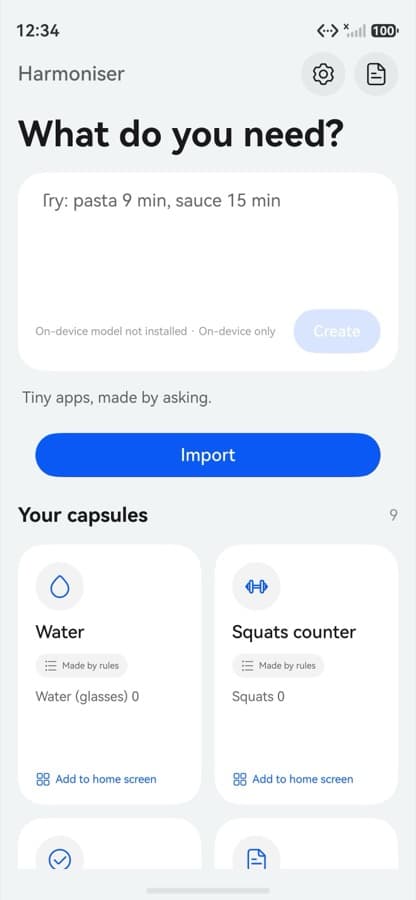
Type what you need — “pasta 9 min, sauce 15 min” — or tap an example. A rule parser answers instantly; the on-device model handles many of the rest with no network; a cloud model is optional and off by default.
Step 2
Approve
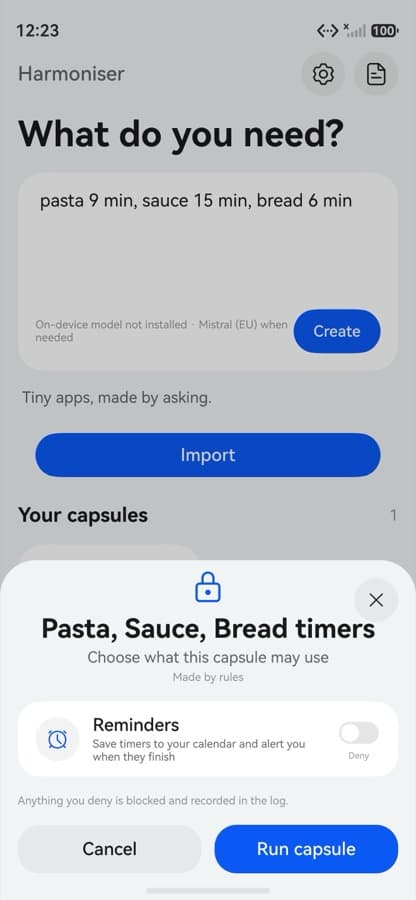
Harmoniser shows every permission the capsule needs and lets you allow or deny each one. A denied feature is drawn as blocked, refused when tapped, and written to the log.
Step 3
Use
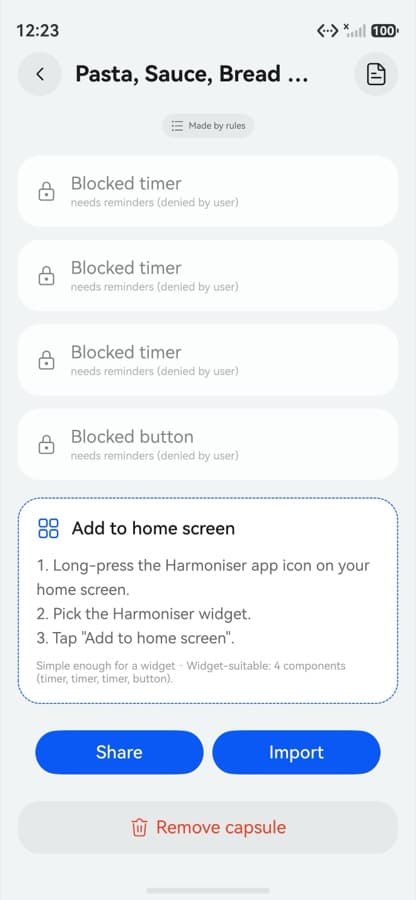
The capsule runs natively: timers ring, counters count, checklists tick, and capsules that fit can live on your home screen as a widget.
What makes it different
No code inside a capsule
A capsule is JSON, checked against a strict schema. Unknown fields, types and actions are rejected. Schema v1 expressions are parsed by our own parser — never eval.
On-device first
Rules run offline. The on-device model (LFM2-VL-450M on the Cactus engine) runs locally with telemetry stubbed out. Cloud AI is a switch you turn on, and your API key is never packed into the app.
Permissions are the API
A timer needs reminders. A motion counter needs motion. The validator rejects anything undeclared, and the gatekeeper is the only path to the device.
The capsule marketplace
Share a capsule you made, or install one someone else published. Publishing is anonymous: your owner token is the only delete credential, and the marketplace stores just its hash. Every download is a JSON file that goes through the app's own validator and permission sheet before anything runs.
Where capsules run today
- Phone: the tested target, API 20+.
- Home screen: 2×2 and 2×4 widgets for capsules the router allows.
- TV and watch: coming next — device pairing preview.
- ESP32 wrist prototype: a lab stand-in, not a Huawei device; the phone gatekeeper still decides what may be sent.